


It's a rite of passage at beehiiv: within a week of starting, every new hire gets an email from "me" asking for something. If you have employees, it's happening to them too.
New hires are the easiest targets for spoofed emails, fake invoices, and sketchy calendar invites. And with AI, the fakes keep getting better.
Surfshark One catches what a tired eye misses:
Scam protection flags phishing links and scam sites before you click, across email, browser, and texts.
Antivirus blocks malware hiding in attachments and downloads, in real time.
VPN encrypts your connection, so no one can snoop on your data over public Wi-Fi.
The full Surfshark One bundle (VPN, antivirus, ad blocker, and scam protection) is $2.49/mo on the 2-year plan. That's the same price as their basic VPN plan.
Don’t let one bad click undo years of work.

We just got rid of titles at beehiiv.
Here’s the manifesto I shared with the team:
One of our core values is customer-obsession. In the early days, the only thing Ben, Jake, and I did was listen to customers and build what they asked for. We had no titles, our responsibilities blended together, and the only thing that mattered was delivering value to customers. Ben and Jake didn’t have titles for the first two and a half years after we launched. They would just jump into whatever project would have the most impact for customers.
As we’ve grown, we’ve added a lot of operational complexity. Transparently, I think much of it is unnecessary. Today we spend far too much time on internal operational matters that our customers never see or benefit from. That moves us further from our mission: to power the next generation of media and the creator economy.
This makes us vulnerable as a company. Here’s what I mean — every hour we spend on internal processes is an hour we’re not spending on what matters: doing our jobs, listening to customers, building new products, and improving our service. That’s how companies start to atrophy. They slow down, decisions that should be simple become complicated, meetings are spawned to discuss other meetings… and the competition takes advantage.
Put even simpler — that means slower growth and less revenue. Less revenue means less upside for the company, fewer opportunities to invest in our people, and less value in the equity each person holds. Nothing is guaranteed. Startups have been hot one day and gone the next. In the worst case, all of the equity that we have worked so hard to earn could be worth zero.
I won’t let that happen to beehiiv.
Titles are a clear example of that overhead. Managers and leaders spend real time defining levels, debating who fits which title, normalizing titles and roles across different teams, negotiating with candidates and employees over leveling, and lining up pay with title bands. None of that time goes to customers.
The Yankees don’t put players’ names on the back of their jerseys: it’s about the name on the front, not the name on the back. As much as I hate the Yankees, I love that, and it fits who we are. It’s backed by one of our core values: ego comes second, and winning comes first.
“WE hit our Q4 goal and surpassed $40M ARR… and I played a part in that by doing X, Y, Z” is how we win together. I believe tackling hard problems and playing a part in the company’s success is more rewarding, and more fun, as a team sport than as a solo pursuit.
We’ve worked incredibly hard to build a winning culture here. It’s the most important part of my job, and ensuring that we maintain this culture in our next stage of growth is my top priority. We look for plenty of things when deciding whether a candidate is right for beehiiv. One red flag I’ve grown increasingly aware of: people who chase titles for internal jockeying and validation over the well-being and success of the greater company. That mindset holds us back.
So to get back to our roots and focus on what matters most — delivering value to customers — we’re simplifying how we operate and moving away from individual titles internally at beehiiv. That includes me and the leadership team.
I recognize that titles are important to many people and that this isn’t a small change. Titles reflect your experience, your accomplishments, and the work you’ve put in to get where you are. None of that changes. I also recognize that titles can provide a sense of progression and clarity about where you stand in your career. I want to be clear that we’re not taking away your ability to grow, advance, or be recognized for your contributions. We’re changing how we describe our roles and refer to one another internally.
Externally, you can represent your role and responsibilities in a way that reflects your work. Internally, we want to put more on what we accomplish together. At the end of the day, it’s the beehiiv name we’re all working to build. Inside beehiiv, what matters is the name on the front.
Everyone at beehiiv, including the founders and the leadership team, is now described the same way: by job family, plus “Lead” if you manage people. For example:
Engineering
Engineering, Lead
Growth
Growth, Lead
People Operations, Lead
“Lead” means you have direct reports. It’s the same whether you lead two people or twenty. It describes what you do, not your rank, and there’s no separate leadership designation.

Is the new system perfect? No. But I sure as hell don’t think the old one was either. And when I’m stuck choosing between two imperfect systems, I’ll choose the simpler one every time.
Here’s a real example. We had a candidate we really loved, but they refused to accept the job without a Director title (they’d been a Director in their previous role).
The problem: we didn’t have any Directors at the company yet. And someone on a tangential team was more experienced than the candidate but had a “lesser” title. I knew that person would be frustrated by the unintentional leveling if a new hire in a similar role walked in with a more senior title.
I was right. They messaged me a few hours after we announced the hire.
Now I had to right-size that person’s title, which would ripple out to everyone else on their team, who would suddenly feel the need to jockey for a new title too. Conversations shift from “how do we solve this problem for the customer?” to “how do I get a more senior title?”
Now multiply that across (almost) every new hire we make, and every round of promotions we announce. No change happens in isolation. Every one has second-order effects that result in meetings, negotiations, and meetings about other meetings.
You can’t tell me the old system was perfect. Worse, you can’t tell me the hundreds of collective hours we spent in meetings about title changes did anything for our customers.
I’d flirted with this idea for years, but it really crystallized when I listened to David Senra’s episode with Luca Ferrari, the co-founder of Bending Spoons. You can watch the five-minute clip here.
There are three objections I hear most often when I pitch a title-less org. I addressed each of them in the FAQ that went out to the team alongside the manifesto:
1. “How am I going to know what other people do at the company?”
When was the last time you needed help from someone on another team, opened Bamboo, pulled up the org chart, studied everyone’s titles, and then decided who to contact? Probably never.
This would be a bigger challenge at a 5,000-person corporation. But we’re a small, lean organization and plan to stay that way. Almost everyone shares what they’re working on each week at All Hands, so everyone should have a great sense of who does what.
And the reality is that most people interact with the same dozen or so people week to week. You don’t need titles to remember what those people are responsible for.
2. “Will this impact my ability to advance my career and get other jobs?”
You still own how you present yourself externally. Put whatever (reasonable) title you’d like on your LinkedIn and resume.
Speaking candidly as a hiring manager, I don’t put much weight on titles. A Staff Engineer at a Fortune 500 company and a Staff Engineer at a five-person startup have wildly different experience and scope. Titles are impossible to calibrate across companies, industries, and regions. Hiring managers care about what you contributed and where you did it.
For example, I’d be far more excited about a candidate coming from a company like Anthropic than someone with a sexier title at a failed startup. Having been part of a high-growth company says a lot about your ability to grow and contribute in one. In my experience, the company on your resume opens doors in a hiring process, not the title.
beehiiv being wildly successful is better for you as a future candidate. Being able to speak to your contributions is what sets you apart.
3. “How are others at the company going to acknowledge my growth?”
Outside of a few people in the (former) C-suite, whose titles I legally had to reference many times, I honestly couldn’t name anyone’s title at the company today. That’s not because I don’t care about you all (I do). It’s because I don’t go to people for help based on what their LinkedIn says. I go to people I know have experience in a specific area and have shown they can move quickly and get things done well. I’m confident other managers and employees work the same way.
Your growth will be on full display as you take on more responsibility, lead harder and more important projects, present more often, run external meetings with stakeholders, and do everything else that already happens naturally here. None of that shows up in a title on a resume.
I hate to break it to you, but most people here don’t know your title either.
Maybe that’s a bit harsh, but it’s true.
It’s impossible for me to get an honest pulse check from the entire company, but I did get a handful of overwhelmingly positive replies after the announcement:

Getting rid of titles is just one piece of something bigger.
We’re gearing up for an absolutely monster 2027. Like, ending-the-year-at-a-near-$100M-revenue-run-rate type of year. To make that happen, I’m rallying the troops and making sure the entire company is aligned and positioned to get there.
I’m going full founder mode (again).
When I was in Cannes, I chatted with Steven Bartlett for an hour. My biggest takeaway was how he builds culture at his companies.

One thing he does: every single candidate takes a culture quiz. If they score below an 80, his team won’t even take the interview. He also participates in the hiring process for every single candidate.
Everyone points to Elon personally interviewing the first 3,000 employees at SpaceX. At first it sounds simple and obvious. Then you realize that as a founder you’re being pulled in 9432 different directions at any given moment, and hiring the 7th account manager feels just a tad less important than securing your next round of funding so you don’t go out of business.
So you reach for one of the most dangerous words in business: delegate.
I’m not arguing that founders should never delegate. I’m arguing that the caliber of people on your team is by far the most important factor in your company’s success. And if you agree with that, you shouldn’t hand the most important decisions to someone else.
Steven convinced me that an hour spent in the interview process saves countless hours later dealing with the wrong hire. The company will only go as far as the team can take it.
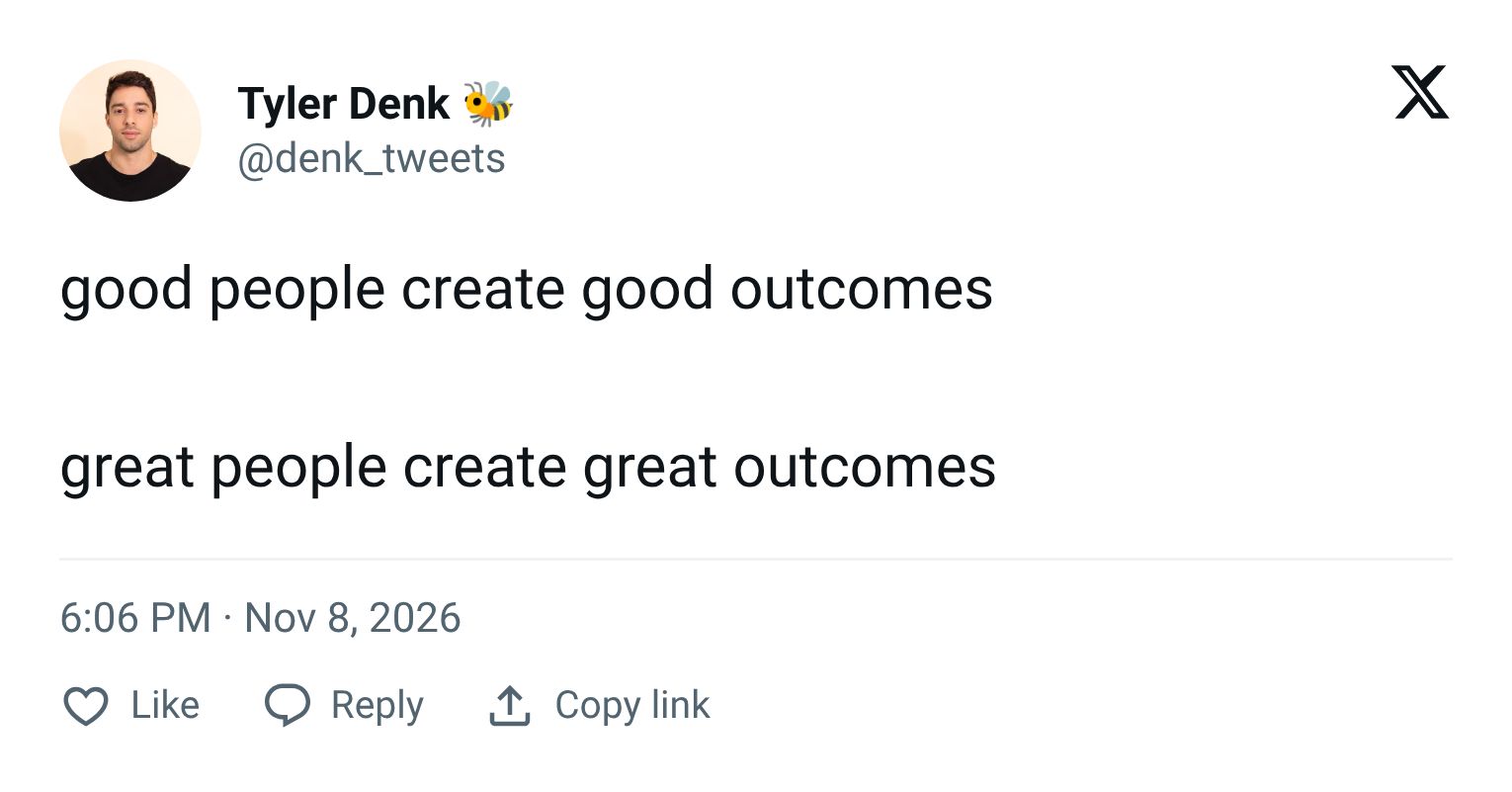
So a few weekends ago, I vibe coded a culture quiz for beehiiv, calibrated it for the people who are going to take this company to the next level, and rolled it out as a mandatory part of the hiring process. Every candidate also now has a mandatory final-round interview with me, where I push them extremely hard on their passion and commitment to making beehiiv the best it can be.
The bar for talent at beehiiv is exceptionally high, and I’m going to make sure it only gets higher from here. One of our core values is “there’s no room for B players,” and enforcing that is genuinely the most important thing I can do to help us grow.
No B players, no more titles, and no company politics. The golden days of beehiiv are here.
If you enjoyed this post or know someone who may find it useful, please share it with them and encourage them to subscribe: mail.bigdeskenergy.com/p/untitled


Credit: Me
In honor of being in Lisbon for Web Summit this week, here’s the office setup that I wish I had. Instead, I’m in some random hotel and hustling from keynote to meeting to dinner to party.
btw if you’re in Lisbon, by the time this hits your inbox you would have missed my keynote (11:55am local time), but drop me a reply and I’ll see if we can kick it.
Think you can generate a better office? Reply with your submissions 📨.

Some of my favorite content I found on the internet this week…
If you’re based in London, next week we’re hosting an evening of conversation and drinks with journalists, creators, founders and media leaders (RSVP)
Next Thursday (11/19) I’m speaking on a free virtual event about growth and I’ll share how we grow beehiiv without lighting money on fire (RSVP)
Haven’t gotten a chance to read the book yet, but this overview of Ari Emanuel’s autobiography was great (Founders)
Data centers were on the ballet last week and lost in a big way (Stratechery)

Turn on, tune in, drop out. Click on any of the tracks below to get in a groove — each selected from the full Big Desk Energy playlist.


Share this newsletter with your friends, or use it as a pickup line.

1 Referral
beehiiv Series B Deck

3 Referrals
$10 OFF BDE Merch
👉 Your current referral count: {{ rp_num_referrals }} 👈
Or share your personal link with others: {{rp_refer_url_no_params}}

What'd you think of this email?
Enjoyed this newsletter? Forward it to a friend and have them signup here.
Until next Tuesday 🕺🏽

📥 Want to advertise in Big Desk Energy? Learn More

